

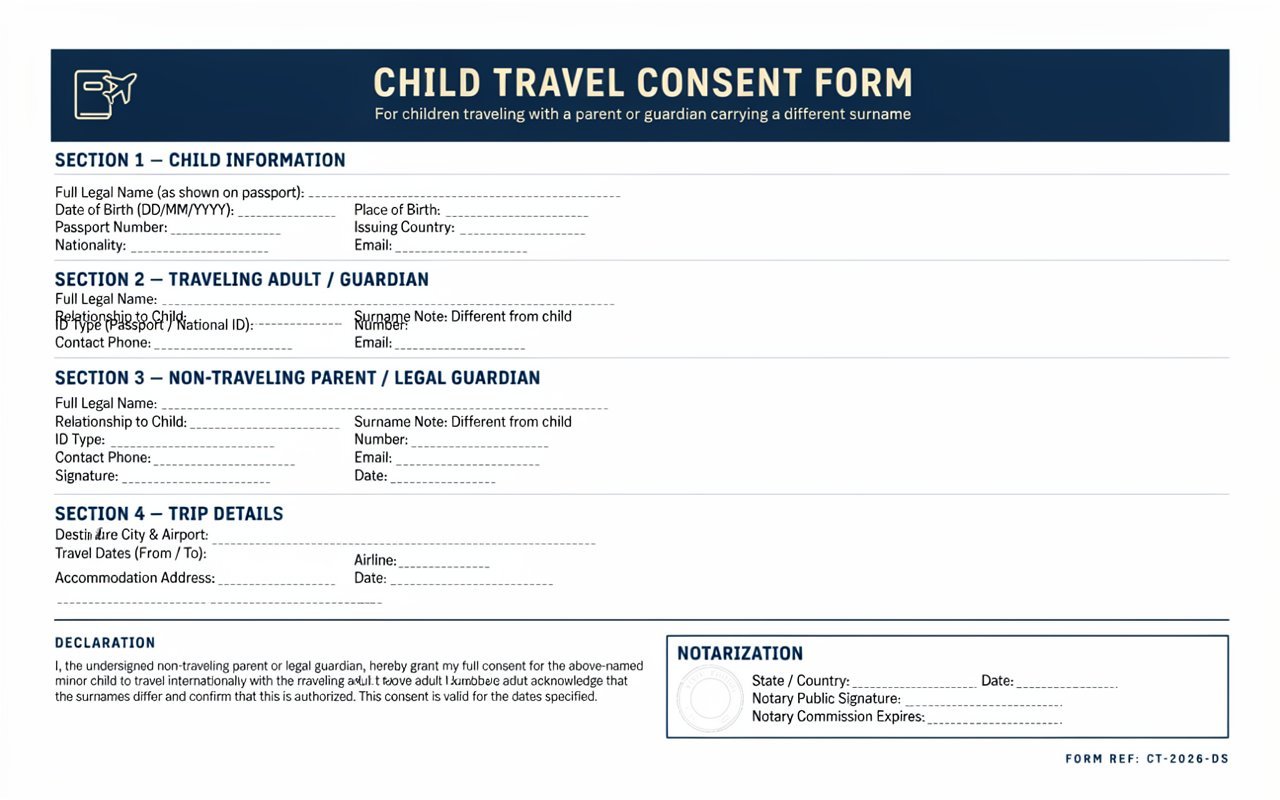
A parent and child can have different surnames for ordinary reasons. Marriage, divorce, remarriage, adoption, or naming traditions may explain the difference. It does not weaken the relationship, but an airline employee or border officer may ask during international travel how the adult and child are connected. A well-prepared different surname child travel consent file answers that question through consistent names, relationship records, parental permission, and usable contact details.
A Different Surname Is Not Proof of a Problem
Officials responsible for safeguarding children may ask additional questions when a relationship is not immediately apparent. The purpose is usually verification, not a presumption that the parent has done anything wrong. The parent should be ready to identify the child, explain the surname difference briefly, and produce documents that connect the names.
A different surname child travel consent packet should tell one coherent story. The child’s passport identifies the child. The accompanying parent’s passport identifies the adult. A civil-status or adoption record connects the adult to the child, while a signed consent letter may show that another person with parental responsibility approved the journey. When each document supports the next, verification becomes easier.
Start With the Child’s Full Birth Certificate
A full birth certificate is often the most direct relationship document because it may show the child’s legal name and the name of one or both parents. Carry the version that includes parent details rather than a short extract that records only the child. Check whether the destination or airline expects an original, certified copy, translated copy, or recently issued certificate.
Before travel, compare the names on the certificate with current passports. A parent’s present surname may differ from the name recorded at the child’s birth. That does not make the certificate useless; it means another document may be required to bridge the old and current names. The different surname child travel consent file should preserve that chain rather than asking an officer to infer it.
Use a Marriage Certificate to Explain a Changed Surname
A marriage or civil partnership certificate can connect a parent’s former surname with the surname now used in the passport. Carry it when marriage explains why the parent and child have different names or why the birth certificate records an earlier name.
The certificate should be legible and should match the relevant dates and names. If the parent married more than once or changed the name through a separate legal process, one marriage certificate may not show the entire sequence. The different surname child travel consent packet should include only the records needed to create a continuous, understandable link.
When Divorce Records Help
A divorce certificate, final divorce order, or decree may help explain why a parent now uses a former surname or why the child continues to use the other parent’s surname. It may also be relevant when travel permission or custody arrangements changed after the divorce.
Divorce itself does not automatically prove sole authority to take a child abroad. A basic divorce certificate often confirms only that the marriage ended. If decision-making responsibility, residence, or international travel is governed by a separate court order, carry the relevant order as well. The different surname child travel consent should remain consistent with every restriction or notice requirement in that order.
Adoption Documents May Be the Main Relationship Evidence
For an adoptive family, an adoption certificate or final adoption order may be the clearest legal record linking the parent and child. The child may retain a birth surname, use a combined surname, or travel before all identity records have been updated. The legal relationship should be proved through genuine adoption records rather than an explanation based only on appearance or shared residence.
A different surname child travel consent packet for an adopted child may include the adoption certificate, current passports, any official name-change document, and consent from another parent or guardian who is not travelling. Some adoption records are confidential or subject to special handling, so ask the issuing authority or a lawyer which form may be carried or certified for travel.
Add Name-Change Evidence Where the Chain Is Incomplete
A deed poll, court order, civil registry extract, or other official name-change record may be necessary when marriage or divorce documents do not fully explain the current surname. This can occur after a personal name change, transliteration change, spelling correction, or change following remarriage.
Check whether different documents use different scripts, word order, spacing, or transliterations. Small variations can be normal, but unexplained differences may delay verification. A certified translation or official record showing both versions may strengthen the different surname child travel consent packet.
What the Consent Letter Should Explain
When the child travels with only one parent, a signed letter from the non-travelling parent or another person with parental responsibility may be requested. The letter should identify the child, accompanying parent, consenting person, destination, departure and return dates, purpose of travel, accommodation, and contact details.
The different surname child travel consent letter should use each person’s name exactly as it appears in the current passport. If a former surname is necessary to understand the relationship documents, include it once in a clear parenthetical note. Avoid long family histories in the permission paragraph; the certificates and orders should provide the evidence.
Government Guidance on Relationship Evidence
United Kingdom border guidance states that travellers may be asked to prove their relationship with a child when they have a different surname. It identifies a birth or adoption certificate, marriage or divorce certificates, and a permission letter with parent contact details as examples of useful evidence. Families can review the official UK guidance for children travelling to the UK before preparing their records.
Global Affairs Canada also recommends a signed consent letter when a child travels abroad without one or both parents or legal guardians. Its child travel consent guidance explains the purpose of the letter and the information commonly included. These sources are useful preparation references, but the destination, transit country, airline, and family court may impose different requirements.
Build a Simple Document Chain
Arrange documents in the order an unfamiliar officer would need them. A practical different surname child travel consent packet may contain:
- The child’s valid passport, visa, or residence document.
- The accompanying parent’s valid passport.
- The child’s full birth certificate or adoption certificate.
- A marriage, divorce, or formal name-change record explaining the surname difference.
- The original signed consent letter where another parent or guardian is not travelling.
- A copy of the non-travelling parent’s ID where appropriate.
- Any relevant custody, guardianship, or court permission.
- The itinerary, return booking, and accommodation details.
Check Translations, Certification, and Legalisation
A certificate issued in one language may not be readily understood in another country. Ask the embassy, consulate, border authority, or airline whether a certified translation is required. Keep the translation attached to the source document. The different surname child travel consent file should reproduce names, dates, seals, and registration numbers accurately.
Some authorities may request notarisation, certification, legalisation, or an apostille. These processes serve different purposes and are not interchangeable. A notary cannot correct an inaccurate certificate or create parental responsibility. Confirm the exact requirement before spending money on formalities that may not be needed.
Prepare for Questions at Check-In and the Border
The parent should be able to explain the surname difference in one or two truthful sentences. For example: “I retained my married surname after divorce, while my daughter uses her father’s surname. Her full birth certificate and our travel consent are here.” The answer should match the documents.
Keep the different surname child travel consent file accessible rather than in checked baggage. An officer may ask who the other parent is, where the family is staying, how long the trip will last, and whether the non-travelling parent agreed. Answer calmly and allow the officer to decide which records are needed.
Related Muvafakatname Resources
For the broader purpose of parental authorisation, read the muvafakatname child travel guide. A supporting-document checklist is available in the child travel muvafakatname requirements. Families preparing documents for a visa or consular file should also review the muvafakatname embassy requirements.
Final Review Before Travel
A strong different surname child travel consent file does not attempt to make different surnames appear identical. It proves the relationship through a clear sequence of official records and shows that the journey has the required permission. Birth and adoption records establish the parent-child connection, while marriage, divorce, and name-change documents explain how names developed over time.
Review the packet shortly before departure. Check passport validity, certificate readability, translations, signatures, court conditions, parent contact numbers, travel dates, and accommodation details. When consent is disputed, records conflict, or a court order may restrict travel, obtain advice from a qualified family lawyer or the relevant authority before leaving.
Legal notice: This article provides general educational information and is not legal advice. Child-travel, custody, translation, and document-authentication requirements vary by country, airline, citizenship, and individual circumstances. Confirm current official rules for the complete route before relying on any consent letter or supporting document.